

Social Control in Religion
How religious systems regulate behavior, identity, and belonging
Social control refers to the ways religious systems regulate behavior, identity, and belonging in order to maintain conformity and authority. Every community has norms and expectations. High-control religious environments go further, using fear, shame, and relational pressure to shape how people think, behave, and understand themselves.
These dynamics are usually subtle, and they are internalized over time. What begins as guidance or shared values can gradually narrow autonomy, discourage questioning, and make belonging feel conditional. Understanding social control helps explain why leaving — or even doubting — can feel disorienting, frightening, or isolating long after the beliefs themselves have changed.
What is a High-Control Religious Group?
High-control groups use social control to recruit, rewire, and retain their members. Two models are especially useful for seeing how that works:
Bounded Choice Theory, developed by sociologist Dr. Janja Lalich, describes how individual choice narrows under group influence — while still feeling entirely free from the inside.
The B.I.T.E. Model of Authoritarian Control, developed by Steven Hassan, identifies the four areas a group works on: behavior, information, thought, and emotion.

“Bounded choice explains how people can appear to choose freely while operating within a tightly restricted psychological framework.”
— Bounded Choice Theory, Dr. Janja Lalich
The Four Dimensions of a Bounded-Choice Group
Dr. Lalich identifies four structures that, working together, produce a self-sealing system — one that holds people without needing to force them.
Charismatic Authority
An emotional bond with a figure — human, divine, or both — that holds people through a mix of love and fear. The leader or the ideology becomes the only trustworthy source of truth, so checking it against anything outside starts to feel like betrayal.
Transcendent Belief System
A total account of the past, the present, and the future, with a clear path to salvation inside it. Because the explanation covers everything, a closed system of meaning forms — and alternatives stop being wrong and start being unthinkable.
Systems of Control
The visible rules, and the consequences for breaking them. Over time the enforcement moves inward: the person comes to self-regulate in line with the group's expectations, with nobody standing over them.
Systems of Influence
The unwritten norms people absorb by watching everyone around them. This is how a group identity is learned rather than taught, until a person's sense of self and their worldview are fused with the group's.
Janja Lalich on Bounded Choice
Her full talk, Bounded Choice: Who Is Accountable?, given at the Extreme Beliefs and Responsibility workshop at Vrije Universiteit Amsterdam. It's a long one — worth saving for when you have the time and the room for it.
Stages of Recruitment
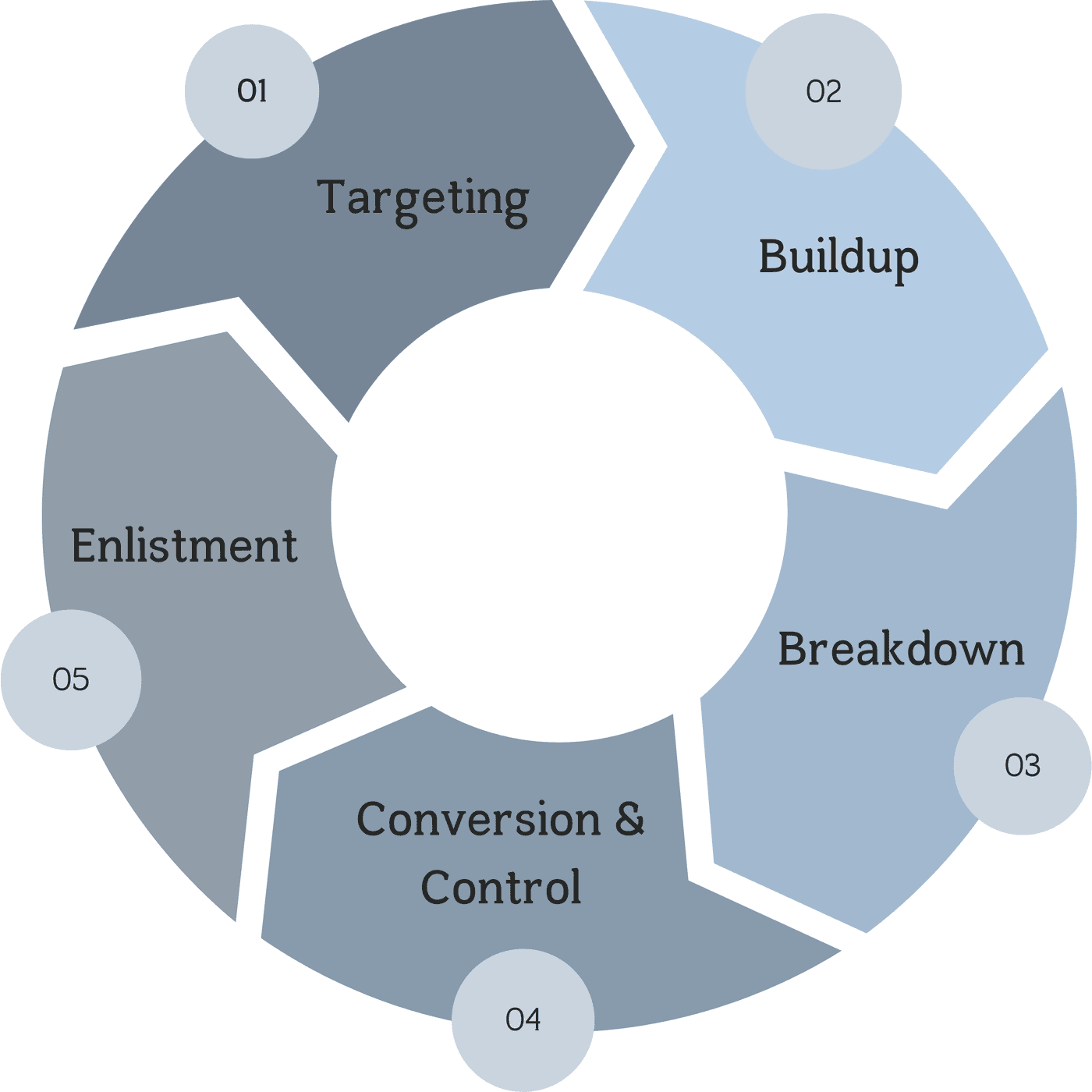
High-control religious groups tend to follow a recognizable arc of recruitment and retention. Each stage relies on emotional connection, fear, and a little more commitment than the last — drawing people deeper in, and making leaving feel steadily more costly.
Targeting
Groups look for seekers, highly conscientious people, and anyone in a vulnerable stretch of life — a move, a loss, a divorce, a first year away from home.
Buildup
Recruits are offered answers to real problems, surrounded with warmth and attention, and promised transformation. Very little of this is insincere, which is part of why it works.
Breakdown
The person is taught that something inside them is broken. Fear-based messaging supplies both the diagnosis and the urgency to do something about it.
Conversion & Control
A public commitment is made. The old identity is surrendered — often ritually — and obedience is reframed as freedom.
Enlistment
Members are expected to recruit and disciple others. Teaching the system to someone else is what embeds it most deeply in the person doing the teaching, and the cycle begins again.
Steven Hassan's B.I.T.E. Model of Authoritarian Control
Where recruitment and group dynamics explain how people become entangled in high-control environments, the B.I.T.E. Model clarifies what is actually being controlled — behavior, access to information, patterns of thinking, and emotional experience.
In these environments, members live under a large number of rules and teachings governing daily life. The expectations are usually framed as paths to moral purity, ways to please God, or means of avoiding divine punishment. Scripture is cited as unquestionable authority for some of them; leaders simply impose the rest.

Behavior Control
Regulating what you do with your body, your time, your money, and your relationships.
Appearance
Rules about clothing, hair, modesty, makeup, tattoos — taught as holiness or humility, and almost always enforced most tightly on women and girls. Your body becomes something the group has opinions about.
Relationships
Who you may date, marry, befriend, or stay close to. Friendships outside the group get discouraged; relationships inside it are supervised, encouraged, or ended by leadership. Family ties can be reframed as spiritual liabilities.
Diet
Fasting, food restrictions, or rules about alcohol and caffeine, framed as spiritual discipline. Extended fasting in particular does double duty — it's devotion, and it also leaves people physically depleted and easier to influence.
Finances
Tithing expectations, pressure to give past what you can afford, and giving that leadership can see and track. Financial dependence on the group — or debt built up giving to it — makes leaving materially harder, not just emotionally harder.
Work
Where you work, whether you go to school, whether wives work outside the home. Unpaid labor for the group gets called service. Career decisions run through the filter of what serves the church.
Time
Services, small groups, volunteer rotations, and events filling most evenings and weekends. When your calendar belongs to the group, there's no unstructured time left in which to think — and no relationships outside of it.

Information Control
Managing what you know, and what you're able to find out.
Deception
Leaving out or softening the truth about the group's history, its finances, its leaders' failures, or what full commitment will eventually ask of you. You said yes to something you weren't shown all of.
Censorship
Outside books, media, teachers, therapists, and critics discouraged or ruled off-limits. Former members get labeled bitter or deceived — which conveniently discredits the most accurate information available about the group before you ever hear it.
Compartmentalize
Information rationed by rank or maturity, so insiders know things newer members don't. Being trusted with more becomes a reward you can earn, and asking about what you haven't been told yet reads as pride.
Monitoring
Accountability partners, discipleship check-ins, and a culture where private struggles get passed upward. Watching each other is framed as love. Very little of your inner life stays yours.
Propaganda
A steady diet of the group's own material — sermons, curricula, magazines, testimonies, conferences, music. No single piece has to be coercive. The sheer volume leaves no room for another way of seeing things.

Thought Control
Shaping how you think — and which thoughts you're allowed to have.
Beliefs
The group's doctrine installed not as one view among others but as the only lens on reality. Alternatives don't get argued with; they get ruled out ahead of time as worldly, deceived, or demonic.
Identity
Black-and-white sorting: saved and lost, in and out, faithful and backslidden. You learn to see yourself and everyone else through that split, and your worth rides on which side you're currently on.
Language
Insider vocabulary that packs a whole judgment into a phrase — a spirit of rebellion, being unequally yoked, biblical womanhood. The words do the thinking for you, and they end the conversation about the thing they name.
Thought Stopping
Trained reflexes for the moment doubt shows up: pray harder, quote the verse, worship through it, take the thought captive. The doubt is never examined — only interrupted, over and over, until interrupting it is automatic.
Manipulation
Guilt, obligation, and love used as levers. Going along gets read as spiritual maturity; hesitating gets read as sin. The effect is that you end up talking yourself into things, which makes it feel like your own choice.
Memory
Your own history retold in the group's language. Life before becomes “when I was lost,” good memories from back then get recast as empty, and harm you experienced inside the group gets remembered as correction you needed at the time.
Anti-Criticism
No legitimate channel for questioning leadership. A concern becomes gossip, divisiveness, or touching the Lord's anointed — so the person raising it gets evaluated instead of the thing they raised.
Forbidden Accountability
Leaders held to less scrutiny than everyone under them. Their authority is described as God-given, which turns an ordinary, reasonable request — show us the books, explain this decision — into a spiritual offense.
Demonization
Outsiders, critics, and people who left painted as dangerous, deceived, or spiritually contagious. The practical result is that the people best positioned to help you think clearly are the ones who feel most threatening to talk to.
Rewriting
The group's account of its own past quietly edited as needed. Failed predictions get reinterpreted, departed leaders stop being mentioned, changed teachings get described as what was always taught. Your accurate memory starts to feel like a defect in you.

Emotional Control
Managing what you feel — and what you're permitted to feel.
Restrictions
Whole feelings ruled illegitimate: anger, doubt, grief that goes on too long, attraction, ambivalence. You get good at performing the acceptable emotion and hiding the real one — eventually including from yourself.
Blocking
Feelings redirected before they're allowed to land. Sadness answered with gratitude, anger with forgiveness, fear with faith. Spiritual bypass, presented as growth.
Gaslighting
Your own perception overruled by someone with authority. What you saw gets reframed, what you felt gets called a bad attitude, what you remember gets corrected — until you stop trusting your read on your own life. This is often the piece that takes longest to heal.
Guilt
A constant low-grade sense of falling short: not praying enough, not giving enough, not surrendered enough. The standard keeps moving, so the guilt never resolves. Over years it stops feeling like guilt and starts feeling like what being a person is.
Fear
Fear of hell, of God's disappointment, of losing your family, of the world outside, of your own mind. Fear does the enforcement, which is why so little external policing is necessary.
Extremes
Emotional life swinging between spiritual highs — camps, conferences, retreats, worship nights — and the flatness afterward. The high gets attributed to God's presence and the crash to your own failure, which keeps you reaching for the next high.
Confession
Sins disclosed to leaders or to the group, sometimes publicly. Whatever you disclose becomes information other people hold about you, and that knowledge is one more thread tying you in.
Phobia Indoctrination
A trained dread of leaving: people who go fall apart, lose their families, lose their faith, lose their souls. It's installed early and repeated for years, so by the time you're actually considering leaving, the fear doesn't feel like something you were taught. It feels like your own conclusion.
The B.I.T.E. Model was developed by Steven Hassan. The categories above follow his framework; the descriptions are my own. Read more at freedomofmind.com
Naming the dynamics is often the first step out.
If you're starting to see your own community through new eyes, that's worth talking about.
Therapy consultations for TN · SC · FL residents · No commitment · Confidential