
What is Religious Trauma?
The lasting impact of religious harm on the mind, body, and self.
Religious trauma develops after harmful religious experiences — including abuse, harmful theology, high-control group dynamics, or the costs of changing beliefs. It is the wound a person carries: to their identity, nervous system, relationships, mental health, and sense of meaning.
Watch
An Introduction to Religious Trauma
The Research Foundation
For most of the 20th century, "trauma" research focused on combat veterans — single, acute events with overwhelming impact. Over time, the field expanded to include what's called complex trauma: chronic, repeated exposure to threat, fear, or control.
Two widely-used definitions:
- SAMHSA: Trauma results from “an event, series of events, or set of circumstances that is experienced by an individual as physically or emotionally harmful or life threatening and that has lasting adverse effects on the individual's functioning and mental, physical, social, emotional, or spiritual well-being.”
- WHO: Trauma involves “exposure to a stressful event or situation of an exceptionally threatening or catastrophic nature.”
The applied insight: prolonged exposure to threat, fear, or control reshapes a person's nervous system, beliefs, and sense of self. When religion delivers that kind of prolonged exposure — through high-control structures, threatening theology, or relational abuse — the resulting injury is real and predictable.
How Religious Trauma Was Named
Dr. Marlene Winell, a psychologist, introduced the term Religious Trauma Syndrome (RTS) in 2011. She described it as the symptoms experienced by people leaving “authoritarian, dogmatic, or high-control religious groups.” While RTS isn't a formal DSM diagnosis, the underlying conditions — anxiety, depression, PTSD, complex PTSD, OCD — are well-documented, and they appear with notable frequency in this population.
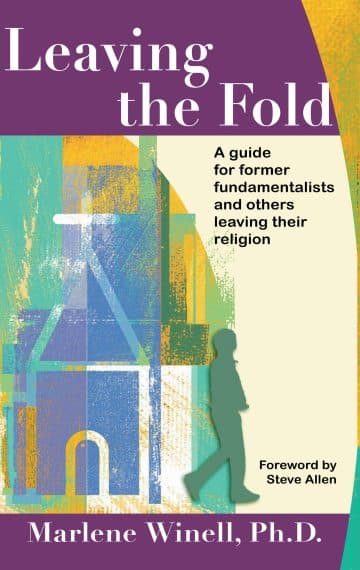
“Symptoms experienced by people leaving authoritarian, dogmatic, or high-control religious groups.”
— Dr. Marlene Winell, who coined the term Religious Trauma Syndrome in 2011
Author of Leaving the Fold and founder of Journey Free.
How Religious Trauma Shows Up
Symptoms cluster into four categories. You don't need to relate to every item for your experience to be valid.
Thinking & Beliefs
- • Intrusive religious thoughts
- • Harsh inner critic
- • Self-doubt, second-guessing
- • Religious obsessions
- • Rigid black-and-white thinking
- • Sense of meaninglessness
- • Existential loss
- • Worldview collapse
Emotions
- • Punishment anxiety
- • Low self-esteem
- • Moral injury
- • Sexual shame
- • Anger, grief
- • Hell anxiety
- • Depression, anxiety
- • Fear of making the wrong choice
Physical
- • Nervous system activation
- • Chronic stress responses
- • Stress-linked medical diagnoses
- • Sexual dysfunction
Relational
- • Isolation
- • Social apprehension
- • Hypervigilance in relationships
- • Difficulty assimilating outside religious community
People experience religious trauma in different ways. You do not need to relate to every item for your experience to be valid.
Free Resource
Religious Trauma Symptoms Checklist
A self-assessment tool you can print and check off privately — covering mental, emotional, physical, and relational symptoms, plus compounding factors that often accompany religious trauma.
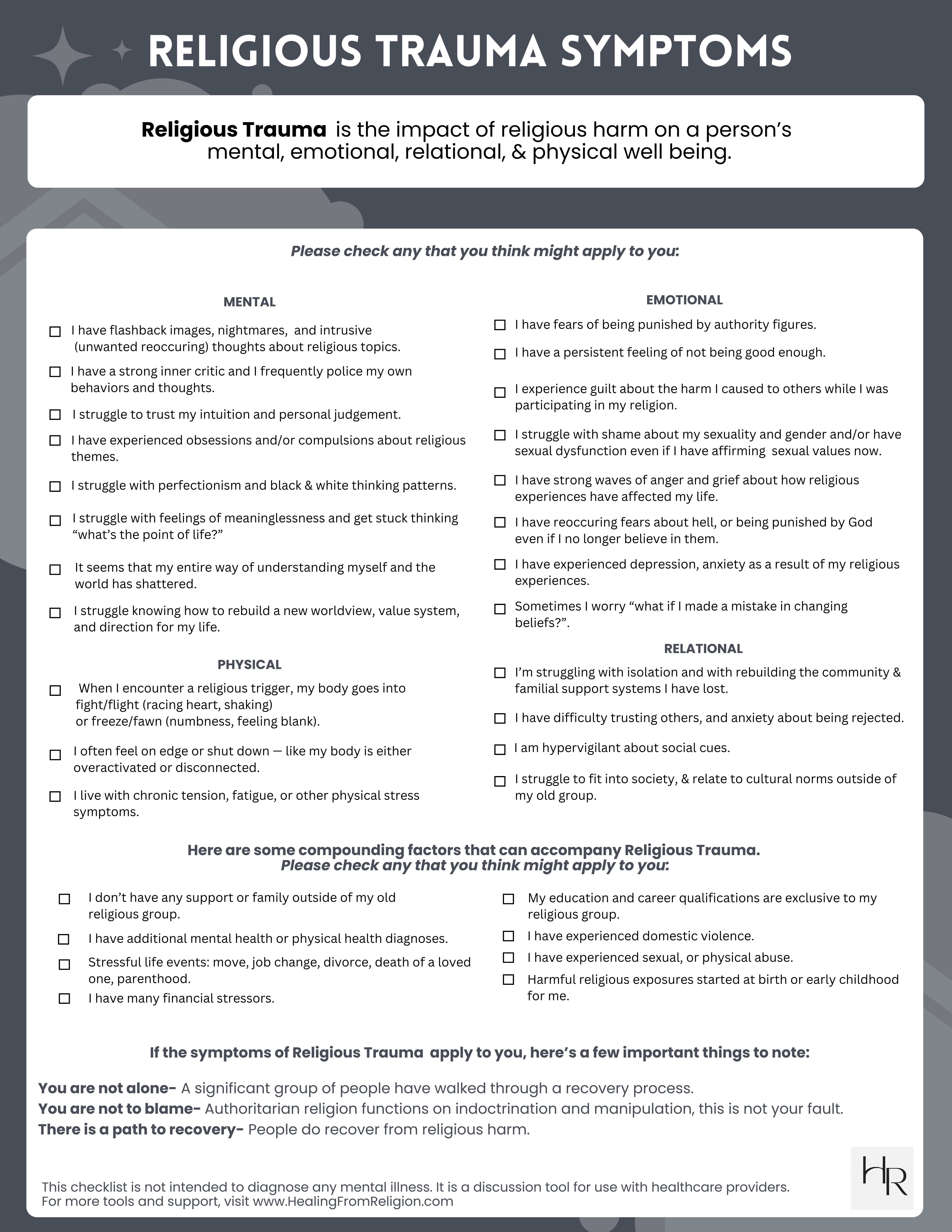
This printable resource walks through the most common symptoms across all four categories — a way to recognize patterns in your own experience and bring them into conversation with a therapist or trusted support.
Not a diagnostic tool — meant for personal reflection or discussion with a healthcare provider.
Download the ChecklistPNG · Letter size · Click image to view full-size
If This Resonates
Recognizing religious trauma is often the first thing that loosens its grip. For most people, the response is some mix of relief (“there's a name for this”) and grief (“all this time I thought it was just me”).
From here, there are a few directions to explore:
- Learn more — the Understanding Religious Harm guide breaks down the specific types of harm. Faith Deconstruction covers the often-overlooked cost of changing beliefs.
- See the path — the Roadmap of Healing outlines what recovery actually involves.
- Get support — for residents of TN, SC, or FL, therapy is available. For anyone, anywhere, workshops are in the works.
Common Questions
Is religious trauma a real diagnosis?
Do I have to leave religion to have religious trauma?
How do I know if what I'm experiencing is religious trauma?
Wondering if this fits your story?
A free 15-minute consultation is the simplest way to talk about it.
Therapy consultations for TN · SC · FL residents · No commitment · Confidential